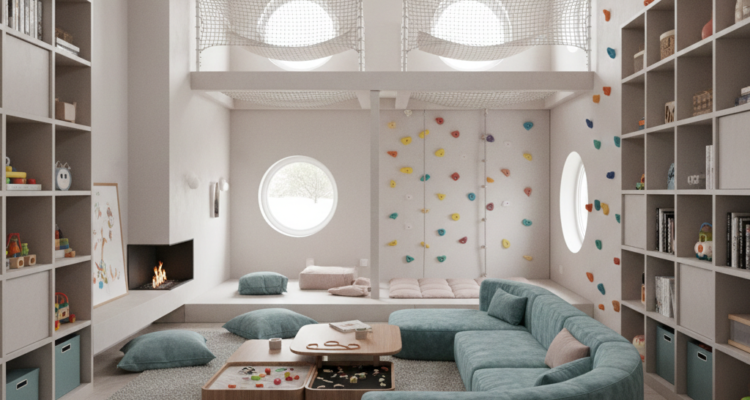
For decades, residential architecture has predominantly catered to the needs, aesthetics, and rhythms of adults. The archetypal “dream home” is often visualized as a space of serene order, sophisticated materiality, and curated design—a sanctuary for relaxation and social entertainment. This paradigm prioritizes clean lines, delicate surfaces, minimalist layouts, and precious objects. It assumes inhabitants who are physically coordinated, risk-averse, and whose primary domestic activities revolve around cooking, working, hosting, and unwinding. From open-plan living areas with sharp-edged coffee tables to high-gloss kitchens and delicate statement lighting, these spaces are designed for a specific mode of adult living. However, the introduction of children into such an environment creates a fundamental clash of worlds, turning a curated sanctuary into a potential battlefield of hazards, mess, and compromised functionality. This article explores the defining features of adult-oriented residential architecture and proposes a framework for intelligent, adaptable design that can gracefully evolve to welcome children without sacrificing core principles of good design.
Deconstructing the Adult-Only Domestic Landscape
Adult-centric architecture is characterized by several key principles:
- The Cult of Permanence and Pricelessness: Materials are chosen for longevity, aesthetic appeal, and ease of cleaning under normal adult use. Think polished concrete floors, silk rugs, marble countertops, bespoke joinery, and exposed sharp corners. Furniture is often irreplaceable or sentimentally valuable.
- Spatial Fluidity for Socialization: The open-plan concept reigns supreme, eliminating barriers between kitchen, dining, and living areas to facilitate adult interaction and hosting. This creates vast, uninterrupted sightlines but also means noise, clutter, and activity have no natural containment.
- Verticality and Inaccessible Storage: Design leverages vertical space with high shelves, tall cabinets, and hanging art. Storage is optimized for adult reach and often designed to conceal belongings completely, promoting a visual ethos of “everything in its place.”
- Sensory Minimization: The ideal is often a controlled sensory environment: optimized natural light, a muted color palette, and acoustic considerations aimed at dampening external noise, not the cacophony of play.
- Fragility as a Design Element: Delicate light fixtures, glass tabletops, unstable decorative objects, and easily stainable fabrics are common, serving as markers of refinement and taste.
This architecture supports an adult lifestyle focused on calm, control, and aesthetic cohesion. It is, in essence, a stage set for a specific performance of adulthood.
The Inevitable Clash: When Children Enter the Frame
Introducing children into this environment immediately highlights its incompatibility. Their needs are fundamentally different:
· Scale & Perspective: The world is experienced from a height of under one meter. High counters, invisible tabletop dangers, and towering furniture dominate their perspective.
· Developmental Imperatives: Children learn through kinetic, often messy, sensory-motor exploration. They need to touch, climb, jump, build, and sometimes make noise.
· Safety vs. Curiosity: Adult spaces are riddled with latent hazards: electrical outlets, unguarded stairs, hard edges, toxic plants, and small ingestible objects.
· The Need for Autonomy: A child-friendly environment allows for safe independence—accessible places for their belongings, spaces they can modify, and zones where they can play without constant adult intervention.
The result of this clash is typically one of two outcomes: the home becomes a fortress of “no’s” and protective barriers, stripping it of its aesthetic intent, or the adults live in a state of perpetual anxiety, policing their children’s interaction with the space.
A Blueprint for Adaptable Harmony: Solutions for a Transition-Ready Home
The solution is not to design a “nursery-style” home from the outset, but to incorporate layered, adaptable principles into the initial architecture that can be activated or modified. This is “Life-Stage Adaptive Design.”
- Spatial Zoning & Flexible Boundaries:
· The “Adjacent Play” Principle: Instead of a fully open plan, consider defined zones separated by wide arches, partial-height walls, or sliding panels (like large barn doors or Japanese-style screens). This allows a child to play in a “contained” area within sight of a parent working in the kitchen, without toys invading the entire living space. Acoustic considerations can be integrated.
· Dual-Purpose Rooms: A home office can be pre-wired and spatially planned to easily convert into a bedroom. A formal dining room might initially serve as a library/playroom, with built-in shelving designed to later house china or collections.
· The “Safe Base” Bedroom: Design children’s bedrooms from the start to be generous, well-lit, and capable of housing multi-functional furniture (e.g., beds with integrated storage, robust built-in desks). This makes the room a true sanctuary for the child, reducing the need for their activities to dominate shared spaces.
- Robust, Layered Materiality:
· The “Forgiving Floor” Strategy: Install beautiful but durable hard surfaces as the foundational layer: wide-plank oak, high-quality luxury vinyl tile, or stained concrete. These can be warmed and softened with large, machine-washable area rugs (like those from Ruggable) or thick, durable wool rugs. The rugs can be rotated or stored during early, messier years.
· Indestructible Surfaces: Specify countertops and table surfaces that resist stains, scratches, and heat. Engineered quartz, solid surface materials (like Corian), or sealed butcher block are excellent choices. For walls, use high-quality, scrubbable matte or eggshell paint in forgiving, warm neutral tones that can serve as a backdrop for colorful art and toys.
· Textural Integrity: Choose fabrics for upholstery that are performance-grade: crypton, microfiber, or heavy-duty cottons and linens. Leather, while an investment, ages beautifully and is easy to clean.
- Adaptive Storage & Furniture:
· “Now & Later” Storage: Design built-in cabinetry with adjustable shelves. The lower half can be configured with open cubbies, bins, and low hooks for a child’s easy access. As children grow, these can be reconverted into closed storage or display space.
· Investment Pieces that Adapt: Select primary furniture (sofas, dining tables, beds) for longevity, durability, and timeless design. A solid wood dining table will bear the scars of craft projects and homework with character. Avoid ultra-delicate, trend-driven pieces for main areas.
· Modular & Mobile Elements: Incorporate lightweight, movable storage units (like the IKEA Trofast system on casters) or modular seating that can be reconfigured for fort-building or separated to create individual quiet nooks.
- Integrated Safety & Autonomy:
· “Invisible” Safety: Architecture can pre-empt hazards. Rounded drywall corners (bullnose finish), stair railings with vertical balusters too close for a child’s head to fit through, and outlets placed higher on walls are subtle, permanent fixes.
· Promoting Independence: Include a low, shallow sink in a mudroom or half-bath for little hands. Design a “kid’s pantry” cupboard in the kitchen with healthy snacks and their plates. A low bench in the entryway empowers them to put on their own shoes.
· Sensory Modulation: Designate a “quiet zone”—a window seat nook, a tucked-away reading corner—for moments of overstimulation. Conversely, plan for a “loud zone” (a basement corner, a playroom with sound-absorbing panels) where noise and energetic play are permitted.
Designing for the Narrative of a Family
A home is not a static museum piece but the stage for a family’s evolving story. By moving away from a rigidly adult-centric model and embracing the principles of Life-Stage Adaptive Design, we create homes that are resilient, graceful, and deeply humane. This approach does not demand the sacrifice of beauty or sophistication; rather, it redefines sophistication as intelligence, foresight, and flexibility. It allows architecture to be a supportive, silent partner in the chaos and joy of family life—a backdrop that can be soft and safe for tiny explorers, yet remain a place of order, beauty, and respite for the adults who care for them. The most successful family home is not one frozen in childhood or in an idealized adulthood, but one that thoughtfully accommodates the journey between the two.

We Don’t Just Design Buildings; We Engineer Landmarks that Stand the Test of Time.
Let’em Know !
Share with friends and family.