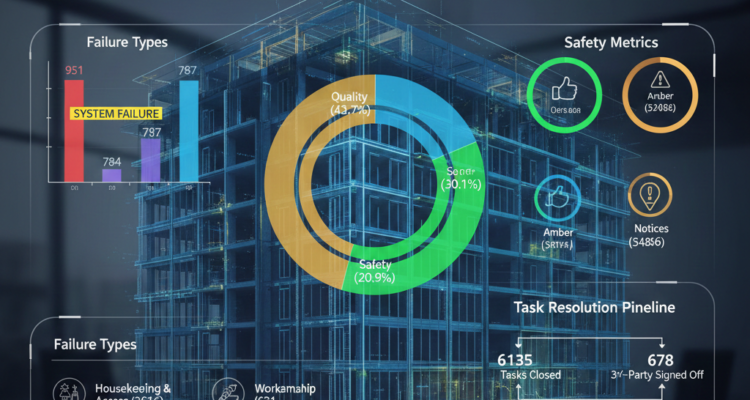
An analysis of 1,659 construction tasks from an active project reveals surprising patterns about how our designs actually get built—and where they consistently fail.
The Ghost in the Machine
As architects, we live in the realm of intention. Our drawings represent perfect outcomes—materials meeting precisely, sequences flowing logically, details executing flawlessly. But a recent deep dive into actual construction project data reveals a different reality. Across 1,659 documented tasks from a multi-block residential project, patterns emerge that challenge our assumptions about how buildings really come together.
This isn’t theoretical critique—it’s empirical evidence from the trenches of construction. What follows is an analysis combining raw project data with architectural insight, revealing where our designs succeed and, more importantly, where they consistently encounter friction in translation to reality.
The Dataset: A Mirror to Our Practice
Project Scope: Mixed-use development with four building blocks, multiple trade packages
Timeframe: June 26 to September 15, 2020 (peak construction phase)
Data Points: 1,659 documented tasks including safety observations, quality defects, progress photos, and coordination issues
What makes this data particularly revealing is its granularity—each entry records not just what went wrong, but where, when, and with which trade. It’s a forensic record of architectural intent meeting construction reality.
The Hard Truth: Design Accounts for Only 3.5% of Documented Issues
Here’s the statistic that should give every architect pause: Only 58 of 1,659 tasks (3.5%) required design team input. At first glance, this seems like success—our drawings are apparently 96.5% problem-free!
But consider the alternative interpretation: By the time issues reach the documentation stage, they’ve already become construction problems rather than design opportunities. The data reveals a pattern of reactive problem-solving rather than proactive design optimization.
What Those 3.5% Actually Involve:
· Ambiguous details: “JPC to coordinate general items—gas skid and pipe location”
· Missing elements: “Ensure Anti-Crack Bars are installed”
· Specification conflicts: “This is not Rockwool loose insulation”
· Interface gaps: “Gap at cill (refer BDA comments also)”
These aren’t minor oversights—they’re fundamental design communications that failed to translate to construction clarity.
The Real Cost: Safety Implications of Design Decisions
Safety issues constituted 56.5% of all documented tasks—a staggering proportion that directly implicates our design decisions. The data reveals specific patterns:
Design-Induced Safety Challenges:
- Access Limitations: Multiple instances of “toe board missing” and “handrail missing” at designed openings and edges
- Working at Height Issues: 22 documented cases related to accessing our designed elements
- Material Handling Problems: Storage and movement challenges traceable to our material specifications and spatial allocations
- Temporary/ Permanent Conflicts: “Scaffolding/propping interface” issues at designed interfaces
A particularly revealing entry: “Block 3 level 7 access/material storage”—a direct conflict between our designed spatial allocations and construction sequence needs.
The Quality Gap: Where Drawings Meet Reality
The data reveals 189 quality issues, with disturbing patterns in recurring problem areas:
Recurring Quality Failures:
- Weatherproofing Details: Multiple instances of “EPDM tape delaminated” and “Illbruck tape to be sealed properly”
- Interface Management: Consistent problems at window-to-wall, duct-to-structure, and cladding-to-structure junctions
- Sequencing Conflicts: “Flatpack duct not sealed laterally” reveals coordination gaps between trades
- Tolerance Issues: “Gap between slab and wall to be dry packed” shows cumulative tolerance problems
The pattern is clear: The more complex the interface, the higher the failure rate. Our pursuit of architectural complexity creates exponential construction risk.
The Phantom Trade: Temporary Works
Nowhere is the disconnect between design intent and construction reality more apparent than in the realm of temporary works—the invisible scaffolding of construction that our drawings consistently ignore.
Documented Temporary Works Issues:
· “Scaffold materials left in area” (multiple instances)
· “Props to be removed so stairs can be used”
· “Double height scaffold/propping interface”
· “Temporary lighting required on multiple levels”
Each entry represents a moment when our designs failed to account for how the building would be assembled, not just what would be assembled. We design finished states; contractors build through sequences.
The Communication Breakdown: What Gets Lost in Translation
The data reveals specific patterns in communication failures:
Most Common Documentation Gaps:
- Sequencing Requirements: “Walls to be plastered prior to install of AC unit”
- Protection Specifications: “Protection to sashes glass required”
- Interface Details: “MC 16 EPDM tape to be sealed around window frame”
- Tolerance Specifications: “Gap to be sealed with 150mm Illbruck tape”
Each represents a missing link between our design intent and construction execution.
The Block-by-Block Reality: Not All Designs Perform Equally
The data reveals striking variations between building blocks:
Performance Disparities:
· Block 3: Highest concentration of issues (particularly courtyard elevations)
· Block 1: Most progress photos, suggesting better documentation
· Block 4: Emerging issues as work commences
· Block 2: Relative stability in documented issues
This variation suggests that design consistency doesn’t guarantee construction consistency—site conditions, trade allocations, and sequencing create unique challenges for each block despite similar designs.
The Human Factor: Trade-Specific Patterns
Different trades encounter different challenges with our designs:
Trade-Specific Issues:
· Ceilings & Partitions: 205 tasks—mostly housekeeping and storage issues
· Precast Concrete: 112 tasks—primarily tolerance and sequencing
· Temporary Electrics: 93 tasks—access and coordination problems
· Mechanical: 75 tasks—interface and protection issues
· Scaffolding: 72 tasks—access and safety conflicts
These patterns reveal which trades struggle most with our designs—valuable feedback for future detailing priorities.
The Timeline Revelation: When Problems Emerge
The data reveals a disturbing pattern in issue emergence:
Issue Discovery Timeline:
· Immediate: Safety and access issues identified early
· Medium-term: Quality and interface issues emerge as work progresses
· Long-term: Coordination and sequencing issues become apparent during integration
This suggests our current review processes catch problems too late—by the time issues are documented, they’re already impacting construction progress.
The Cost of Complexity: A Quantitative Analysis
The data allows us to quantify the impact of design complexity:
Complexity vs. Issues Correlation:
· Simple interfaces: Lower issue frequency
· Complex junctions: Exponential increase in documented problems
· Multiple trade interfaces: Highest failure rates
· Custom details: Greater variance in execution quality
This isn’t speculation—it’s empirical evidence that complexity has quantifiable construction costs.
The Opportunity: Data-Informed Design Evolution
This analysis reveals specific opportunities for architectural improvement:
- Design for Construction Sequence
Every detail should include:
· Temporary support requirements
· Trade access sequencing
· Protection timing specifications
· Inspection access provisions
- Simplify Interfaces
Based on the data, prioritize:
· Reducing different material junctions
· Standardizing interface details
· Creating forgiving connections
· Designing for adjustment
- Communicate More Effectively
Our drawings need to show:
· Construction sequence diagrams
· Critical interface priorities
· Tolerance accommodation strategies
· Protection requirements
- Design for Reality, Not Perfection
The data shows we need to accommodate:
· Trade sequencing realities
· Site condition variations
· Material availability constraints
· Weather impacts on sequencing
The New Architectural Metric: Buildability Index
What if we measured our designs not just by aesthetics or sustainability, but by buildability? This data suggests specific metrics:
Proposed Buildability Metrics:
- Interface Complexity Score: Number of different material junctions
- Trade Coordination Index: Trades required at each construction phase
- Temporary Works Impact: Scaffolding and support requirements
- Inspection Access Rating: Ease of quality verification
From Drawing Board to Building Site
This data analysis reveals a fundamental truth: Our designs are not just aesthetic or functional statements—they’re sets of instructions for complex physical assembly processes. And like any instructions, they can be clear or confusing, efficient or wasteful, safe or dangerous.
The most telling insight from this data might be what’s NOT documented: the thousands of small adaptations, workarounds, and improvisations that contractors make daily to translate our designs into built reality. Each undocumented adaptation represents a small failure of our design communication.
The Path Forward:
- Embrace Construction Feedback: Treat construction issues as valuable design feedback
- Design in Four Dimensions: Include time (sequence) as a design parameter
- Simplify Ruthlessly: Complexity has quantifiable costs
- Communicate Proactively: Assume nothing, specify everything
- Measure Buildability: Track how well our designs translate to construction
The buildings we design will increasingly be judged not just by how they look or perform, but by how efficiently and safely they can be built. This data gives us the tools to improve—not through theory, but through empirical evidence from the construction front lines.
Our challenge is clear: Can we evolve from being designers of finished states to becoming choreographers of construction processes? The data suggests we must.
This analysis is based on 1,659 documented construction tasks from an active project, representing a comprehensive view of how architectural designs translate to construction reality. The patterns revealed offer actionable insights for improving architectural practice, communication, and ultimately, built outcomes.
The next frontier in architecture isn’t just better design—it’s designing for better building.

We Don’t Just Design Buildings; We Engineer Landmarks that Stand the Test of Time.
Let’em Know !
Share with friends and family.